Tuesday, March 17, 2015

Magic-Whence Cometh?

It may have seemed like I was about to get into Shamans. But I hadn't quite hashed out the background necessary to discuss them.
Actual Shamans, and people in Shamanic societies have what is called an "enchanted worldview." They believe that spirits are real, and that the realm of the numinous is near-at hand, though invisible. It is something very real; to be respected or feared, and typically quite mysterious. The shaman is the person who intercedes between humans and this other realm. They typically do this by inducing an altered state of consciousness. This altered state can be atained in a number of ways. They believe this altered state allows them to interact with the spirit world.
It is in this otherworld that the shaman becomes capable of "magical" abilities such as shape-shifting, passing without a trace and interacting with otherworldly beings.
What is going on here?

If we wanted to simulate this sort of thing in D&D, how could we go about it?

As is, we really can't. There is a mention of the astral or ethereal plane. But I have never been able to find a description of what these places are supposed to be like. And the canon Planar Cosmography of D&D is a mess. I guess we could use it could serve in a pinch though.


It gets really bad when you add Spelljammer (fantasy space) into the mix.
 
All this is to say that a druid/shaman is not required to move through other planes to use their powers. They cast their spells per day and use abilities normally on the Prime Material Plane, going about their daily business. They don't even have to be "in nature" to draw on the power thereof. They don't even have to get naked and dance.  
 
Where does Magic come from?
 
You could have a whole campaign centered around answering this central question.
Most of the time however, the campaign will be about something else: Race Wars. The disposition of a magical maguffin. Foiling the agenda of a progressively-minded villain. Repelling an Alien Invasion. Survival. So magic in the setting will be taken as understood.
 
It seems that players will default to having their characters speak of magic in  exactly the terms by which it is described in the rulebook: Arcane Spells, divine Spells, schools of magic, spells per day. Does it not seem odd that the characters in the setting have such precise knowledge of the deep workings of their universe? Feigning ignorance of magic (if you have a fighter or barbarian) is considered cute at first, but is quickly abandoned for how much it seems to bog down the flow of the game.
 
So you wind up with magic which is ubiquitous, disposable and not understood by its users. Like fast food. Whenever someone casts Magic Missile, they typically do it with the same level of enthusiasm they would display when ordering a combo at McDonalds. Or less.
 
I don't know about you guys, just can't have that and call it "fantastic." 
Here are some ways I've been thinking of presenting magic. They are pretty out-there, and dependent upon the flavor of the setting.
 
The Sakaguchi/Amano approach
Entities have inherent magical powers which they cast as easily as thinking or exercising a muscle. I named this approach after the producer and artist behind the Final Fantasy franchise. FF was originally an attempt to do 8-bit D&D. But it developed its own flavor. If you look at Amano's art, everything has an ethereal, otherworldly appearance which seems to indicate the spiritual, magical status of a character as much as anything else.
 

David Bowie, according to Yoshitaka Amano.
 
In these games, even warrior-type characters seem to have vast reserves of some inner power. Except instead of typical spell-like effects, their power gets channeled into shiny sword-beam attacks or wire-fu style acrobatics.  Wizard-types cast elemental or healing spells, and seem to be able to project energy. But they can't do specific, fine-tuned effects like "alter self" or "mage hand."
Since these magic powers seem so inborn to a character, I would base it off ability scores. It also kind of begs a system to define a character's morality, since a character's personality seems to affect the flavor of their powers. If you want to do magic this way, the rest of the stem would have to be suited to it.
 
Magic as Fantastic Technology
Like mundane technology, magical effects are reliable and reproducible. It's just like starting a fire or what happens when you mix baking soda and vinegar. Except in a world with components from magic herbs or monster's body parts, the range of possible effects extends into the uncanny.
This seems intriguing because it allows anybody to learn or use magic tricks, so long as they have the necessary ingredients and can perform the necessary recipes. The burden would fall on the game designer to invent a number of spell-recipes, and on the game master to make them available in the game. 
Here's one:
Pulverizing the scale of a Behir and vigorously rubbing the dust between your hands will allow you to use Shocking Grasp, once with each hand. This renders the dust inert and useless. An adult Behir has 50+3d6 usable scales. 
 
Magic as Incomprehensible Technology- The Vancian Standard
Arthur Clarke is often quoted "Any sufficiently advanced technology is indistinguishable from magic." This is pretty much what is going on with the wizards and spellcasters in Jack Vance's Dying Earth Stories.
Vancian magic is the original basis of spellcasting in D&D. Magic is explained as a highly advanced form of mathematics. A spell is a mental formula which must be memorized, and is so complex that only a limited number can be known at any time. This is why wizards have to be smart.
The introduction of sorcerers and warlocks blows this all to crap though.
 
Actual Technology as Magic
The contrasts between clerics as "divine" spellcasters, and wizards as "arcane" spellcasters always seems to me to indicate a division between Faith on one hand, and science and technology on the other. If we take this literally, then a spellcaster's power manifests as physical devices. Spell components become the assorted equipment the "wizard" must carry. Research cost become just that. Burning hands becomes a flamethrower, detect magic becomes a Geiger counter or EMF detector. Homunculi and golems become robots.
If you played a wizard in D&D and described his spell-casting as such, it would come off as tremendously gonzo (saving that one for my post-apoc, no humans, Bakshi-esque campaign where elves live on reserves and run casinos) I am mostly just saying that your technologist takes the place of a Wizard in sci-fi or no-magic settings.
 
Magic as Inherently Alien and Destructive.
They said that the occult was of the Devil. But what if They were actually right? In certain weird, horror or pulp settings, magic is suspect at best. Tarzan, Conan, Solomon Kane, and John Carter wouldn't touch sorcery and you know it. Magic is not merely a technology, but something truly unnatural; anathema to reality.
This is a rather niggling, intuitive feeling that you can get about magic: A few words or gestures yields effects of great power. Nothing is free though. If conservation of energy is held true, then some awful price is being paid somewhere else.
I have a pet theory that all magic is effectively summoning; summoning a little heat, a little electricity, a little force from somewhere else in Creation. But the transfer is not 100% efficient. There is some "friction" to it. The normally "closed" systems of the universes are opened to each other, and entropy is allowed to work on an extra-cosmic level. These transfers progressively break down the physical laws of the universe. This is why technology frequently doesn't work in high-magic settings and vice versa.
Eventually, when things like gravity or electromagnetism stop working reliably, a universe could be so fragmented and chaotic that it is effectively ruined.
 
And what of the clerics and their gods? The gods know this secret. They will risk the destruction of a few worlds to further their own agendas. Got to break a few eggs.
 
Quantified Magic
I want to analyze some spells and determine how much energy and power they require in precise, mathematical terms. The object would be to set limits on the power-rating of a given spellcaster. This would give the caster freedom to design spells and magical effects. The limit on magical power would be a numerical value, and not arbitrary distinction. Energy necessary to repair the crystalline structure of a broken sword: minimal. Energy necessary to repair complex living tissue: significantly more, and it may require a knowledge of medicine as well.
This might annoy people who dislike doing physics in-game though. But imagine how much power you would have if a simple "mass-effect" was among your low level spells. With Quanitfied magic, you would have that freedom.
 
I promise, my next post will be something actually useful in game and not pure speculation.

PS. Magic as a function of Will.
A friend reminded me of this possible setup, and it needs mentioning. This is the explanation for Magic used in White Wolf's Mage: The Awakening. In this universe, reality is perception. (Or is perception reality?) a Mage's power comes from their ability to bend their own mind. By thoroughly altering their own perception, reality is altered in turn. Various magical traditions provide different means to convince one's self of new realities. Of course, since all minds share the same reality, creating an obvious magical effect which contradicts a bystander's perception can have negative consequences for the offending mage. This mechanic provides a balance for this free-wheeling explanation of magic. Anyways, World of Darkness is a cool setting and system. So it is always worth mentioning.   


Monday, March 16, 2015

2d10 - Thing to Try

I stated to my group that I had an Experiment I wanted to perform when next I ran.
This was answered by very loud eye-rolling from several.

But this is not how I would like for my precious readers to respond. If I write about a thing I would like to try and game, please, dear readers, try to ask me about it after a month or so.

Basically, I want to run a session or two rolling 2d10 for checks where we would otherwise be rolling a simple d20.
The object of this is to yield a bell-curve of probabilities, thereby eliminating the manic crit/fail dichotomy which has become central to D&D and the d20 system. The d20 is a capricious god, and it has been thoroughly fetishized. This becomes apparent if you look at a handful of captioned DnD memes.
In fact, if an aspect of the game has become meme-able, I probably want to destroy, decanonize, or undogmafy it.((alignment, magic missile and cat pictures shall be purged))

By introducing a bell-curve probability, I expect players to be able to decide on actions and make plans with reasonable expectations, rather than trusting to chance or having an otherwise reasonable plan fail for no apparent reason.
Also, crits and fumbles seem to come in streaks, and it becomes taxing to the Game Master of come up with explanations for all these extreme happenstances.

Some things to note:
Difficulty classes need to be adjusted.
With 1d20, there is a 5% chance of rolling a natural 20.
With 2d10, there is a 1% chance of a natural 20. So the DC of 20 would become equivalent to 18 or 19.  See spreadsheet


Skill Modifiers become more significant. As the DCs become numerically lower, without making any other changes, the modifiers or bonuses to a roll make a larger difference to the outcome. If the rounding in the conversion above seems stingy, the reason is to balance out the increasingly significant modifiers.
The range become 2-20. 
The chance of rolling 2 is 1%. At this rate, I am ok with still using fumbles and crits. It will bring back the spark back, I'm sure.
With Combat criticals, maybe adjust the crit range.
The rules as-is specify that if an attack succeeds and is inside of a weapons crit range, then the player must roll again and hit in order to get a succesful crit. So to keep critical hits from becoming extinct, maybe eliminate that second roll, or adjust the ranges crit ranges using the chart above. A crit range of 20 becomes 18-20. 19-20 becomes 17-20 and so on.

I am concerned about the scaling of Difficulties and Armor Classes over 20. I'm not sure how to work that out. For now, I will just scale it linearly and see how that works.

I expect to be able to run this in the next month or so. The beauty of our current schizophrenic campaign is that it allows for lots of experimentation. So if bell curves are no fun, it won't hurt much.


Friday, March 13, 2015

Fantasy Saturation

Here's a problem.
In a Fantasy setting, how do you define what is "normal" and what is wondrous or uncanny? To successfully have any sense of fear or mystery in a game, you need to establish a baseline of normalcy to contrast the really weird stuff. This is true in any medium of storytelling. But it presents particular challenges in D&D, where genre-savviness is the norm, and objects and ideas which should be really, really strange have been thoroughly codified and de-mystified by decades of rulebooks and supplements.

In a typical D&D setting, it is as if every graveyard is haunted, kobolds could pop out of the floorboards at anytime without anyone being really shocked, wizards step in and out of other dimensions like they are getting breakfast, and those mysterious, uncanny elves...well there are actually a few drinking and yukking it up in the inn where you are staying.
A dungeon master has to put some actual thought into how to subvert or avoid the tropes.

In a recent campaign, our party came to some foothills where basilisks and achaierai were milling about. Because this was D&D, the presence of these fantastic beasts was not surprising. The surprising part was that they didn't seem to mind us being there. Why weren't they killing us? There was a mystery afoot, and I think it was one of my favorite moments playing in that campaign.

Or consider the source material that gets all the credit; Lord of the Rings. "Fellowship" starts pretty slow; a long expected party and plain little hobbits and idealized pastoralism written of in a sing-songy grandfatherly tone. At this point in the story, Elves are numinous creatures, interchangeable with fairies in the average hobbit-mind. This sets the baseline of normalcy. But then the stakes get raised. The poor little hobbits are rushed onto the road without much explanation. They have their first encounter with a Black Rider. The hobbits are nearly powerless; avoidance is their best strategy. And it is genuinely scary. Only when we get to the Council of Elrond does the tension abate. The hobbits and the audience are finally clued in on the scope of the conflict. And the conflict is pretty large, but understanding something about it does a lot to eliminate the tension. At this point in the story, the elves entertain us at dinner and change our linens. Ignorance in the face of potential danger is a key element of that delicious fear we were experiencing earlier. Familiarity on the other hand, breeds contempt.

oldest emotion fear fear of unknown Lovecraft and so on
 
But if played well, familiarity can breed even more, deeper fear:
 
(whimper)
 
A big aspect of establishing what is normal in a setting is the races and classes which are available to PCs. This why it is perhaps NOT a good idea to have tieflings and half-dragons and drow-elves and magic-robots in the core rulebook. It will inevitably demystify all of these ideas.
 
Let us consider Professor T's very own race of immortal Mary Sues: the elves. the Elves of their native Norse mythology lived in Asgard and served as the helpers and servants of the gods. They were essentially divine in themselves. It was these creatures which Tolkien was trying to interpret in his own writings. In Medieval Europe, after the spread of Christianity, elves were demonized. I dare say a lot of people believed in them, but feared them or any possible interaction with them. Now that makes for good weird fantasy! Then you get D&D, and an elf is suddenly a skinny punk with a d6 hit-die, who takes himself too seriously and gets pushed around by the dwarf who has a sturdier center of gravity. It's a bit of a step down from divinity. Elves have gotten so cliché that even saying "My elves are different." has become a cliché.
My Elves Are Different: the manga
 
I'm not saying we should get rid of elves as a default playable race. That ship done sailed. I'm just saying that when everything in the setting gets taken for granted, it becomes difficult to have any really meaningful fantasy. Attempting to create new ideas can come off as more bizarre and gonzo than genuinely interesting.
It's fantasy saturation. They've got a glass of water and put as much kool-aid in it as will dissolve. It. Can't. Get. Any. Kooler.
 
If it seems like I am always trying to deconstruct D&D, this is the reason why. D&D has become a setting as well as a system. I am picking through the assumptions that have been built into it in hopes that the baseline for normalcy can be reset. I believe that if that baseline can be reset, we will have new frontiers of mystery and danger to explore. Question your assumptions, says I.
 
Btw. In that campaign with the disconcertingly docile monsters; the Elves were the bad guys in the end. Elves do make good villains.


Wednesday, March 11, 2015

Druids- historical and otherwise

I told you the druids had it coming.
I don't know how it is for you all. But it seems to me like first-time players choose to be druids by a significant margin. I can guess why this might be the case.
Druids are well rounded. Their selection of healing, offensive and utility spells, along with the decent hit-die and the animal companion give them lots of tools and options, even to the point of being effective for (gasp!) solo play.
They get a lot of power, and don't have to pay much for it: Maintain a neutralish alignment. Take some mild weapon and armor restrictions. No big. Better yet, their power comes from "nature" and not some stodgy, demanding deity.
(AD&D was better about limiting the druid, as they had very demanding prerequisites, and forced druids to participate in a druidic hierarchy reminiscent of that described by Caesar.)

Also, If you believe that art in the books influences the game (and I do) you might agree that the depiction of the druid is a big factor. Vadania the druid is the only female character in the book who seems to have both physical appeal and girlpower. The other female copyrighted sample characters tend to make people gag. Keep in mind, I'm mostly talking about 3E. 5E makes a huge improvement in the art department.

If this is the most inspiring female figure in your book, we have problems with the franchise...

This post isn't going to be a huge deconstruction of druids, because I don't have any particular alternate solution to propose. (We could use the religious rigor = spellpower rules that I proposed for clerics and just substitute nature for "deity," if that even fits the campaign setting. I'm not entirely content with that setup though.)  

This post is just a commentary on the ideas behind druids.

D&D druids are pretty much necessary to the game because they fulfill a particular archetypal role in the mind of the players. They get interpreted as wise men, wild children, beast-masters, shamans, lost boys and man-eaters. But in general, they represent an outlook and spiritual path which is more basic and primal than that of the cleric. A druid is to the cleric as the barbarian is to the fighter. 
As far as I can tell, D&D druids were largely inspired by the works of Terry Brooks and his Shannara series. But I've never read those, so I can't say to what extent.

Druids are also interesting because more than any other class, they are based on an actual, historical group.
Most people know that Druids were from ancient Celtic society. They were not an ethnic group, nor even a religion in themselves, but rather a class of priests and religious functionaries. 

We really do not know much about them. Druids left no writings of their beliefs or practices. According to Julius Caesar's book "Commentary on the Gallic Wars" the Druids transmitted their knowledge to initiates strictly by rote memorization of an oral tradition. So great was this body of knowledge that an apprenticeship could last 20 years! Now, ones enemies can usually be counted on to write interesting things about one, if not with perfect objectivity. But for the mere reason that there is no other record of Druidic doctrine, we may as well believe Caesar on this one.

In fact, almost all we know about Druids, comes from a few paragraphs here and there by their great enemies; the Romans. Notably Caesar's Bello Gallico chapter 6 section 13 (VI  XIII lol)  a few notes in Tacitus' Agricola, Diodorus Siculus and Strabo. Pliny the Elder even describes a Druidic rite in his "Natural Histories" which explains the association of sickles and mistletoe to the D&D druid. 

Taken together, the picture these Roman ethnographers paint is something very different from the free-spirited D&D druid.

Historical Druids were a class of highly respected and authoritarian priests.  They were the one-percenters of their time, with great power concentrated in a few individuals. They were a highly learned group, knowledgeable in medicine, divination, astronomy and natural sciences. They also served as judges. They payed no taxes and were never called upon to fight in wars, and the purpose of this was perhaps to maintain their neutrality in issues of justice. They had the power to excommunicate any who disobeyed their orders, and that individual would become a shunned outlaw. They did not encourage individual spiritual growth or any such modern, liberal philosophy. Rather, they were intermediaries between the rest of society and a pantheon of gods. Caesar names these gods in Roman terms; as Mercury, Mars, Minerva and so on.
What the Druidic equivalents of these gods were, or what they were named, I cannot say. But I can suggest with confidence that there were Celtic deities corollary to Roman deities. The same archetypal deities existed all over heathen Europe, with only local variations. We can see evidence of this today in how we call the days of the week in different languages


Druids also officiated over Human Sacrifices. Pretty much all Roman authors agree on this, and none gainsay the notion. Here is an account from Diodorus Siculus:

"especially, when they deliberate on matters of moment, they practise a strange and incredible rite; for, having devoted a man for sacrifice, they strike him with a sword on a part above the diaphragm: the victim having fallen, they augur from his mode of falling, the contortion of his limbs, and the flowing of the blood, what may come to pass, giving credence concerning such things to an ancient and long-standing observance. They have a custom of performing no sacrifice unattended by a philosopher, For they say that thanksgiving should be offered to the gods by men acquainted with the divine nature and using the same language..."

That's one hell of a spell component there. And just for a divination! Caesar describes another terrible rite which involved burning multiple live men in a giant wicker effigy. The victims were typically criminals, if criminals were available. But hey, they believed in reincarnation. So why not? The Celts can be credited for their practical notion that the gods cannot be cheated, and that only blood can pay for blood. The rite of the Wicker Man continues in a slightly sanitized form to this day.


If any of you actually try to get a wicker man going in game, I will be really impressed.
Basically, real Druids were everything that we moderns hate about organized religion, and then some. Modern day apologists argue that all these unpleasant things were merely Roman propaganda. But recent archaeological discoveries of bog burials and suspicious corpse-piles seriously challenge this cuddly denial fantasy.
Let's leave the fantasy in the game and keep it out of scholarship, shall we?

These ideas about toothless Druids and peaceful goddess-worshiping heathens have their roots in the Celtic Revivalism of the 18th and 19th centuries. Neo-Druidic groups exist today. But Neo-Pagans really don't have much to reconstruct from, and they essentially have to make up their religion as they go. (As opposed to a mainstream religion where everything is already made up for you.)

"The Druidess" Alexander Cabanel. There is no reason to believe that historical Druids were ever anything other than male. Still better than Vadania though.


Druids are not what we imagined them as, are they? Do you feel as let down as I did? Power from nature indeed! Their power was the same as any other evil old priesthood. Might as well just play a cleric!

So if our D&D druid is not a Historical Druid, then what is it? Well, let's consider their powers. Knowledge of plants and animals. Shape shifting. A resistance to the lures of the fey. The ability to pass unseen. Poison resistance. Dude. That's not a Druid. That's a Shaman.


And Shamans are a whole other kettle of peyote.

D&D Bible History-Tobit

Getting into roleplaying games and D&D ruins your life.
Jack Chick and Patricia Pulling and Rona Jaffe and all those other Satanic Panic luminaries were right. They just didn't have the specifics of how quite right.
Page 4

Once you start playing, your frame of reference changes. Pretty much everything you encounter suddenly becomes quantifiable as a level or ability score. When you start Game Mastering, you begin to analyze things in terms or how you might relate them in a game. Every stupid History Channel "documentary" becomes inspiration, especially the entirely made-up ones.
Pretty soon, you look back over things you were taught to take seriously, which other people take seriously, and it has all become questionable. Everything is up for debate because you have seen it all shown in a fictional context, in a game nonetheless.
Exercise in fiction teaches you the possible range of fiction, and how it seeps into everyday life. You begin to guard very strictly the borders between the Definitely Real, The Possibly Real and the Definitely Fictional


After thinking like this for long enough, you become such an opinionated Crystal Fortress Wizard that you are unfit for polite society. Your loved ones are embarrassed by your dinner conversation and dread going out to eat at nice places.
Wizards who live in crystal fortresses know they shouldn't cast magic missile, and they have to keep a lot to themselves. Pretty soon find they themselves compulsively writing stuff like this to keep their sanity:

Dungeons & Dragons Bible History- The Book of Tobit

"Tobit"is my very favorite bible story. It is set in the 8th century BCE when the Hebrews were under the Babylonian Captivity (purple part of the map below). Its first few chapters are told from the perspective of the eponymous Tobit, who claims descent from the tribe of Naphtali. (one of the twelve tribes of Israel)
Tobit begins by telling about how the tribe of Naphtali was deported to Nineveh. In the Hebrew perspective, Nineveh was like the New Jersey of the Ancient Middle East. But if the conservative Hebrews disliked it, that means it was probably a pretty happening place where people knew about things like astronomy and how to safely prepare pork.
Tobit complains about how all his fellow tribesmen (except for him) went to eating non-kosher foods and worshiping the golden calf of Baal, which was the popular deity in Nineveh at the time.

But Tobit was righteous and spent a lot of time and money in Jerusalem, tithing to the priesthood and all that. So Jehova blessed him with a sweet gig as a merchant, and Tobit lent a large sum of money to a cousin in Media (orange part of the map). This money comes up later in the story.

Tobit was also in the habit of burying the corpses of strangers, but only so long as they were Jewish corpses. He thought of this as a sort of charity, and not that weird at all. This got him in trouble with the local king Sennacherib (who was responsible for the preponderance of Jewish corpses in the first place.) Tobit and his wife Anna, and son Tobias, skipped town. Eventually, Sennacherib was deposed by his sons and Tobit was able to come back to Nineveh. Which is curious since he disliked the place so much.

One night, after burying corpses outside the city walls (again.) Tobit fell asleep in the open air and a sparrow shat in his eyes. This made Tobit blind and doomed him to poverty. Whether the blindness or the poverty was less pleasant to him is up for debate. Tobit prayed to Jehovah for death or deliverance, whichever Jehovah was feeling up for.


Meanwhile, In Ecbatana in Media, there was this Jewish homegirl, named Sarah, daughter of Raguel, also of the tribe of Naphtali. And she had problems of her own.
The Demon Asmodeus (Persian name; Aeshma-Daeva) was in love with Sarah. And Sarah had been married seven times, but every single time, before she could consummate the wedding, Asmodeus would pop up and kill the dude! Imagine how frustrated Sarah must have felt. So she also prayed to Jehova for deliverance. And Jehovah decided to knock out two birds with one stone.

Tobit was feeling the icy hand of death upon him, and he decided to tell his son Tobias about the money that Gabael in Media still owed. Tobit also gave a speech about the importance of Charity, and that Tobias should not marry a foreigner, but only a woman also of the tribe of Naphtali. Not even another tribe of Judah was good enough for Tobit. He was really serious about keeping the old line going.

Tobit told Tobias to find a guide to accompany him on the road to Media. Except Jehovah had already sent the angel Raphael to go in disguise and guide Tobias. Tobias met Raphael and brougth him back home to meet Tobit. Then Tobit decides to ask the angel what his name and tribe are. it is getting pretty clear by now that this whole Tribe thing is a big deal to Tobit.
So Raphael lies and says that his name is Azarias and that he also Naphtali. In Tobit's mind, these are the only necessary credentials, so Tobias and the Angel go off to Media together.

The Party camped by the banks of the Tigris. When Tobias went to wash himself, he encountered a giant fish and was nearly eaten. The Angel Raphael then told Tobias to get the fish. And Tobias was cool with this suggestion. There was an exciting combat which ended when Tobias grappled the giant fish and threw it onto land.
Raphael/Azarias instructed Tobias to cut open the fish and remove it s liver, heart and gall. The next day, Raphael explained that these organs are, in fact, spell components; useful for repelling demons and curing blindness of all things.

The party stopped in Ecbatana at the dwelling of Sarah and her family. Ancient people were pretty big on hospitality as a rule. And when they found out that they were all related, naturally, everyone decided that Tobias and Sarah should get married. Tobias was a little hesitant because he had heard about the 7 previous husbands. But Raphael told him to be cool and remember the spell components.

So Raguel and his wife Edna lead Tobias into Sarah's chamber (in a tent?) Then Raguel snuck off to dig a grave for Tobias, just in case. Meanwhile, Tobias burns the fish heart and fish liver in a brazier and the smoke is sufficient to drive Asmodeus back to Egypt (presumably where demons come from.) Tobias and Sarah then safely consummate their marriage.
Raguel then fills the grave back up and throws a wedding-feast which lasts a fortnight. Raphael the Angel goes alone to collect the debt.
As soon as he could politely disengage himself, Tobias returned to Nineveh with his new wife and bags of money in-tow. Tobias then used the fish-gall as a poultice for his father's eyes, restoring his sight.
And Tobit gave praise to Jehovah and they all lived happily ever after because they were rich again.

So there you have it, the Book of Tobit, only roughly paraphrased. But what are we supposed to take from it? This book is often referenced for its lessons on charity or filial devotion. Except, in context, This so-called charity is restricted to members of the same race/religion (The Hebrews are a race defined by their religion,) And this "filial devotion" is more like glorified nepotism and incest.

One almost wonders if Tobit was intended as a parody or a satire. The tribe of Naphtali comes of as a morbid, usurious, incestuous and treacherous bunch. Once could hardly write a more crassly anti-Semitic smear on purpose. But I fear that this writing really was in earnest, and represents the actual values of the author. And who can really say this is an incorrect ideology? From a certain, very brutally true perspective, a bloodline is the only truly important part of a human. Offspring extend your mortality. The measure of an organisms success it largely the extent to which is spreads and preserves its own genetic code. If you were like Abraham, and your goal was to have descendants more numerous than the stars (Genesis 26:4), it would only make sense to have a code of morality which takes this bloody principle to its core: Nepotism, incest and genocide would become your virtues. Tolerance, assimilation and miscegenation would become a sin to you.
Note that there aren't a lot of self-proclaimed Babylonians around any more.
On the other hand, if you believe that all of humanity is the same family, and that you are, in fact, your brother's keeper, your values become something; perhaps not the opposite of Tobit's. But they will be more expansive at least.

Warring gods and their cults, race wars, demons and angels, sorcery, sex and monstrous fish. With no adjustment, the Old Testament makes for a campaign setting more intense than most people would even like to have at their tables. I look forward to continuing the D&D bible history series. No one's mythology is off the table to an acute Crystal Fortress Wizard.


Until next time, I should totally have named this blog Crystal Fortress Wizard.

Tuesday, March 10, 2015

Blades

I was going to write about how WotC has weapons all wrong and propose a cleaned-up weapons list. But then I looked and found that 5th Edition already did it, fairly closely to the way I would have. (There should still be a bastard-sword as a step between a full-length single-handed sword and a two-handed greatsword)
 So instead, I'm just going to post pictures of weapons by category, and describe some of my criteria for these classifications. Some images are from museums, others are faithful replicas from merchant websites. (I love you, kultofathena.com)

http://www.beerandbattle.com/wp2/wp-content/uploads/2013/04/DNDWeapons3.5Ed4.jpg
And it did need cleaning up. Are you kidding me, rapier?

The weirdness goes back to Gygax and Chainmail and beyond. But atleast with Chainmail, Gary was trying to represent his subject realistically. He just didn't have the best sources to draw on, and the SCA was still a small club in Berkley at the time.

I think it's important that weaponry be accurately represented in our games. Some will surely protest that D&D is a fantasy game, so orc double-axes and crap like that should be encouraged. Well that's just wrong. Suppose someone wanted to play in a genuine historical setting, or include representative medieval or melee weapons in a modern setting. Besides, for some people, roleplaying games are the gateway into genuine historical interests, and it does not serve them to be utterly fictional where it is not called for.
Besides, unless you are creating a whole history of weaponry and warfare for an alien world from scratch, I guarantee that the truth will be much stranger and more compelling than fiction.

Pre-modern-ness supposes that weapons are hand-made. Proficient smiths had methods and tools for ensuring consistency and proportion in their work, and perhaps a distinctive style. But each weapon was an individual. Extant historical pieces only scratch the surface of the variety which there was, because the really useful, popular weapons tended to get used up!

As is, the existing category of weapons holds up pretty well for rules purposes and for creating distinct tactical choices. I want to explore some of the variation in these categories, and possibly describe how I define their criteria.

Daggers
dirks, stilettos, shivs, bowie knives, Arkansas toothpicks, tanto, survival knives, trench-knives, poigniards, bayonettes, misericords, athames and shaftless spear-heads. If it is designed for hard-use or for combat, it counts as a dagger. (even if it is technically a knife.) If it is a smaller blades (less than 5 inches) and meant for mundane or utilitarian purposes, I call it a knife and say it does 1d3 damage for rules purposes,
The cut-off between a dagger and a short sword is hard to pin down. If the blade is more than 14 inches long, it is probably a short sword though. 
Two daggers from the tomb of King Tutankhamen. One of gold, one iron with a rock crystal pommel.
"But..." I can already hear you asking "If King Tut lived in the bronze age, how did he get an iron dagger?"  Well this particular dagger was made from meteoric iron. This was pretty much the sort of weapon that only a king could have owned.

the Kukri
Added onto 3E as a d4 slashing weapon with a larger crit-range than a typical dagger. The kukri is a peculiar weapon with a lot of fanboy appeal. It is native to Nepal and has a geometry similar to a cut-down falcata.
Traditionally, a kukri includes two smaller accessory knives which fit into the from of the main sheath.

With its forward-curved blade, the kukri is splits the difference between a knife and a hatchet. But I find you might as well just have a knife and a hatchet. Or you might just upgrade to a short-sword since the kukri is just about as heavy and bulky to carry. It still looks cool though.

Short Swords
A short sword is meant to be a side-arm, not its bearer's main weapon. If the blade is 24 inches or less, I call it a short sword.

Chinese Short sword. the metropolitan museum of art. 26 inches long
Short Sword (Duan Jian)


http://www.kultofathena.com/images%5CDT2011_1_l.jpg
The Roman Gladius. one of history's most effective swords. Kult of Athena is a great place to buy medieval weapons, armor clothing and accessories. They have some of the most competitive prices on the internet fyi.

Sickle sword, or kopis (khopesh). The Met. Middle Assyrian ca. 1307–1275 B.C.L. 54.3 cm (about a cubit) Despite its name, the edge is on the outside of the curve, making it similar in geometry to a falcata or a kukri. This sword is of cast bronze. Bronze was only good for short-swords, axes and spearheads because  of the relative softness of the metal.
Sickle sword

 A binakuro. I would place most machetes, even exotic ones like this, in the shortsword category.


Broadswords (called longswords in the rulebook)
Back in the day, they didn't call them broadswords. "broadsword" is a Victorian term which was necessary to distinguish them from the daintier swords which were common at the time (incidentally, chainmail is also a Victorian literary term. Period folk just called it "mail.") In medieval England, all swords were broad, with a blade designed for cutting and chopping. But that doesn't mean the thrust was merely an afterthought.

Broadswords look heavy, but a good one is quite agile. Most are between 2 or 3 pounds
If the blade is between 28 and 36 inches long, and hefty enough to sever a limb or lay a man open, it gets to be a broadsword.

10th c. European  The Met  L. 37 3/4 in. (95.91 cm); W. 4 5/16 in. (10.95 cm); L. of blade, 31 7/8 in. (80.96 cm); greatest W. 2 in. (5.08 cm); L. of grip, 3 5/8 in. (9.21 cm); W. 4 5/16 in. (10.95 cm); Wt., 2 lb. 4 oz.


Tibetan. The Met L. of sword 41 1/4 in. 34 inch blade.
Sword, Scabbard, and Belt Hook


This specimen might be called a rapier on account of its acute point and elaborate hilt. But considering the stoutness of the blade, it is definitely a slasher as well. I would call it a "longsword" for game purposes


European single-edged swords like this are properly called falchions. There are very few extant falchions because they were so popular with soldiers that they tended to get used up.
http://www.kultofathena.com/images%5CANE1_1_l.jpg

Bastard/hand-and-a-half/Longsword
Swords which are long enough that they are slightly unwieldy in one hand, but rather quick and agile in two.
In the rules, they are always called bastard swords. But if you talk to a fencer or re-enactor, they will be called Longswords. The Longsword is also the runner-up to the Katana in "weapon most tainted by its fanboys." Swords like these were capable of extreme versatility, and could even be used effectively against an armored foe. Here is an illustration from the Talhoffer manual


It takes significant skill to use a longsword safely. They are focused on offense, and the wielder must depend upon armor or footwork to avoid injury.

Take a look at this German longsword the met W. 3 lb. 7 oz. (1560 g); L. 49 1/8 in. (124.8 cm); L. of blade, 38 1/2 in. It is quite elegant, with a narrow blade which emphasizes the thrust. But the length and the trigonometry of the pommel being so far back from the hilt render it somewhat awkward for a single-handed grip.
Hand and a Half Sword


Compare it to this reproduction, which has a broader, choppier sort of blade, but is only still a little over 3lbs. It's not the amount of metal. It's the distribution of the metal.
http://www.kultofathena.com/images%5C500800_4_l.jpg

And Katana? I guess the internet's most over-rated weapon could be counted as a bastard sword or a broadsword, depending on the size of the user in relation to the weapon. 

 Two handed swords are just that. Swords which cannot be effectively used with one hand (except for the occasional lucky shot) They are really only of limited utility since you are not likely to carry one everywhere (and they just weigh you down in narrow dungeon corridors) Two-handers are useful against horsemen, or often carried by bodyguards. They allow a single combatant to cover a relatively large area, and hold ground or fight defensively

This Italian 2-hander from the Met. is 6lbs, 2oz and about 66 inches in length.


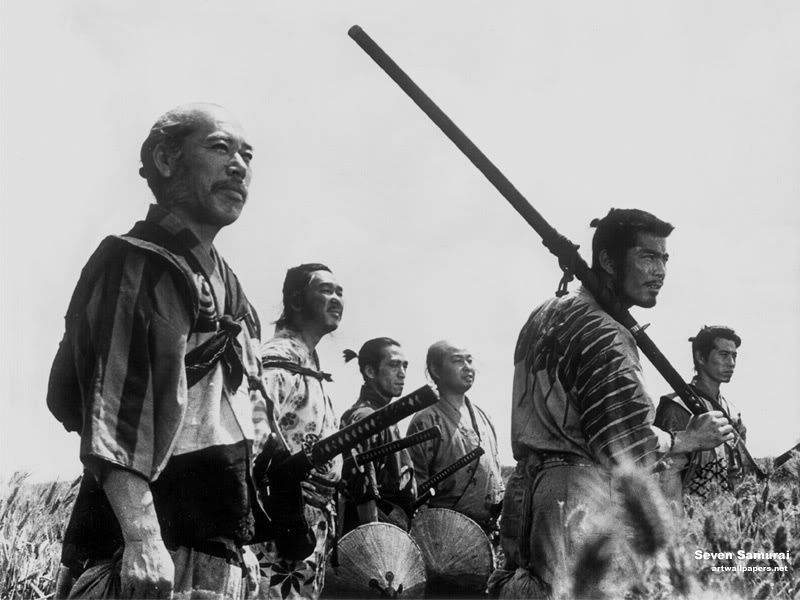
 An over-sized katana is called an odachi, or no-dachi. Here is one in Kurosawa's Seven Samurai.


 Obligatory Claymore

Scottish claymore replica (Albion Chieftain)2.jpg

And if someone asks to use a buster sword in your game, just slap that idiot and send them on their way.

"Scimitars"
Another one of those very vague terms, "scimitar" seems to indicate nothing more specific than a single edged, probably curved sword. In the minds of western Europeans, curved swords were associated with Heathenism and Saracens, which is probably why it is on the Druid's weapon list.
In D&D 3E, it was introduced to indicate a light slashing weapon which depends upon finesse more than strength. For this intent, a Civil War cavalry saber would probably be too heavy for this category. But perhaps these would fit:
Swords like this; with the deeply curved blade and the forward-leaning lobe pommel are alternately called shamshirs, scimitars or mameluke sabers. They are designed as cavalry swords, but are quite nimble in the hand.


Or perhaps lighter variations of the yatagan. Many yatagan are rather thick-bladed though.

Or maybe something like this yanmaodao (goose-quill sword)

Rapiers
The term comes from the Spanish "espada ropera," meaning literally a clothing sword. Rapiers were originally meant to be relatively easy-to-carry weapons which you would wear with your everyday clothes, as opposed to full battle regalia.  They were not designed to harm an armored opponent. George Silver, an Elizabethan English master, despised rapiers and said that they were too deadly for common brawling, and not deadly enough to be of use in service to the crown.
In game, they are counted as thrusting swords which are light enough that they do less damage, but depend on dexterity more than strength.
A prime example would be this American colonial small-sword, which was a development of the rapier. Smallswords typically have blades with a triangular cross-section. This effectively eliminated their cutting potential, but created a strong point which made nasty puncture-wounds.
 Sword

Here is a more typical rapier. This specimen weighs 2 and a half pounds; slightly more than the broadsword above. Once again, it's not a matter of the amount of material, but the distribution of the material.
I would count other light , straight-bladed swords in the rapier category for game purposes. Such as this Jian which has a 29 inch blade and weighs two pounds.


Ugh. That was a hard post to put together! I think I'm actually sick of swords for once in my life. But there's more to come, I haven't even touched axes, spears, bludgeons or ranged weapons. And if you were disappointed by the constructive positivity of this post, don't worry! I am going to tear the armor rules a new one when I get around to it.


Monday, March 9, 2015

Sytems to Try

I'm pretty sure that when I die, I will do so with a huge backlog of campaigns and scenarios I wanted to run. The ideas for campaigns and settings are inexhaustible and seem to generate from each other at an exponential rate, so I don't think this can be helped.

Rules systems are different. There are a few I want to try out. The ultimate goal is to find out what really works in play and synthesize these ideas.

Obviously, I've played a lot of D&D 3E. It came out shortly after I started playing, and it was as if that was what I had to play if I wanted to play at all.

I also played a good deal of White-Wolf's World of Darkness (the 1990's editions) with my college friends. The system is sublimely simple and great for storytelling. It is however, poorly limited and easy to power-play in. You need to trust your players in this one.

Ages ago, I also played BESM 2nd edition. It was a fun, simple system. easy enough once you get past the point-buy character generation. It is also ripe for abuse.

The systems I'd like to play are:

5E D&D. Whenever I try to clean up or simplify 3E, what I wind up with is usually eerily similar to what's already in 5th edition. Friends have witnessed the moments when I have realized this; I get that sensation that my brain cells are being cooked away, and apparently this looks really funny to observers. Spoken to my group: I think maybe we should just make the conversion, cause 3E is kind of a straw man for picking apart.

Savage Worlds. Specifically designed to hearken back to the Pulp Writers of the early 20th century. This system looks wonderfully simple, and easily transferable between genres and settings. Fortunately, I have a buddy who is planning on running a campaign with these rules.

The Dragon Age RPG by Green Ronin Press. Obviously when you take a property which is already pretty much somebody's D&D setting, and make a new RPG out of it, there will be similarities. But the main mechanic in this involves rolling 3d6s, offering a bell curve of probability. I want to see if this is as awesome as I expect it to be.

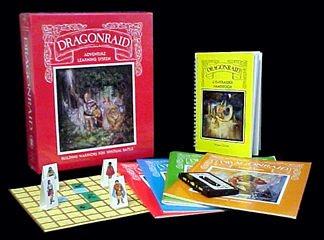
DragonRaid: The infamous Christian RPG. Released in 1984 as a direct result of the Satanic Panic. People believed that D&D was an educational tool for inducting impressionable young folk in to the mysteries of the Occult. So DragonRaid is an educational tool for indoctrinating impressionable young folk in Christianity. It is specifically labeled not as an RPG, but as an ADVENTURE LEARNING SYSTEM. Really though, why shouldn't we be learning things when we play a game? The mere concept may be quite scoff-inducing, but DragonRaid is genuinely a quality product.
The basic package comes with the  main rulebook, a game masters guide, mapping grids, carboard cutout miniatures (I really like these hippy-looking, non-threatening adventurers) , two dice, three adventure modules and a tutorial tape, all for way less than the cost of a new Player's Handbook. The system looks easy to run, and has some features which seem alien, but potentially brilliant. The character sheets have formulae to show exactly how to derive your values. The game is earnestly based on a genuine belief system. Rather than ability scores, your character is rated on goodness, patience, hope and the other fruits of the spirit:

Galatians 5:22-23 (NIV)
22 But the fruit of the Spirit is love, joy, peace, forbearance, kindness, goodness, faithfulness, 23 gentleness and self-control. Against such things there is no law.

Considering that your kindness and patience are determined by a randomly determined numeric value, I foresee all kinds of naughtiness being committed in the name of "role-playing."Also, there are no "spells" but characters may invoke bible passages to gain certain in-game effects. Even better, correctly reciting these verse from memory is how you develop your character! I see some potential for some freaky psycho-drama in this game. I found my copy on amazon.

DragonRaid comes with everything you see here. Yes. Even the cassette tape 
The cassette is eerily warped-sounding though. These boxes have been sitting somewhere since the 80s after all.