Tuesday, October 13, 2015

exploring Basic D&D

A lot of my sensibilities as a D&D player are influenced by the OSR. Most of my favorite writers and thinkers about rpgs are somehow connected to the old school rennaisance.


The games I have played however, have mostly been 3rd edition, with a healthy smattering of the White Wolf  World of Darkness system. My only real experience playing an "Old school" style game was a brief flirtation with Lamentations of the Flame Princess.

I had some problems with LotFP though. Characters seemed to die too easily. Players didn't have time to get used to their characters. Those who had invented detailed backstories for these ill-fated characters found themselves shortchanged on their efforts. As a DM, I had been hoping for a certain threat of lethality, and the tension that comes from it. But the lethality lent more of a slasher-flick absurdity than actual drama. And whats worse, I found that the constant character deaths were holding up  the campaign. Characters were simply not living long enough to witness the wonders I had invented.

Part of the the problem was that I had designed the adventure with 3E sensibilities, with the power creep of 3E in mind. Flame Princess appears to run on a d20-like system as far as combat is concerned, so it seemed like an easy transfer. But rather than adjusting my style to the new system, I just changed the campaign back to 3rd. The increases survivability allowed us to play in the manner to which we had become accustomed.

I had basically given up on Basic D&D. But I still read OSR blogs. Including Monster&Manuals, which is where I found this:

 http://forum.rpg.net/showthread.php?676099-B-X-Misadventures-in-randomly-generated-dungeons

These are play reports and commentary of a few trial B/X games, and then an extended campaign where some of the characters get as high as Second Level.
The odd thing is how genuinely interesting these reports are. They are exciting to read, and that's about the last thing you would expect.

I had been made to understand throughout my roleplaying career that Old School D&D didn't really allow for roleplaying. Supposedly, back in the day, D&D was basically played like a board game, and only later more nuanced systems really had the potential for drama and characterization.

Yet in these play logs, there are well-defined characters, ethical conundrums, drama, and lots of tension. It shows the value and potential of Old School play, and it is pretty inspiring.
  
The rules used were the Basic/Expert rules with very minimal houseruling. These rules were edited by Tom Moldvay and David Cook, and published in 1981. There are two books in the set, Basic and Expert. Basic has rules and tables for characters up through the third lever. Higher levels are described in the blue-covered Expert book. These are the rules usually taken as the basis of the OSR and the various "retro-clones" such as Lamentations.

http://ecx.images-amazon.com/images/I/51QDLXzKvyL._SX379_BO1,204,203,200_.jpg


Some of the key factors I noticed that are different from most D&D games I've played:

>Play began at the threshold of the dungeon. It is understood that the party members already know eachother and are going to cooperate. This saves a lot of bullshit. Shopping and resting are not played out, but simply announced.

>Overland travel was simply announced as a given. But B/X does have rules for it: It amounts to a possibility of a random encounter while moving from one hex to another. This basically extends the length of the gauntlet the party must run.

>Play moves very quickly. The group seems to get through a lot of encounters in a short amount of play time.

>XP is based on treasure acquired: counted when it leaves the dungeon. Monsters are also worth XP, but the risk of combat is not necessarily worth the meager reward.

>A single good hit from an enemy or a trap can mean certain death - especially at low levels. Teamwork and caution are a necessity. This DM gave experience not only for defeating enemies, but also for causing the enemy to flee or talking their way out of a fight.

> Morale and reaction checks are absent in recent editions. But they are key to encounters in basic.

>Resources are very limited. HP and spells evaporate quickly, and there's no telling what's in the next room. The party has to decide just how far to push their luck.

>Dungeons are not cleared; they are raided. The idea is to grab treasure and get out without anybody dying.

>This DM used dungeons made by an online random generators. One called Wizardawn, which seems to be defunct, and another called donjon. There are several tool like this online. While I am usually of the mind that a dungeon should have an underlying logic to it, the upshot of using randomly generated dungeons is that the DM doesn't have to worry about his creativity or ego being on the line and can simply focus on running game.

>There's no (intended) continuity or narrative at stake, so the campaign can be as log or as short as is convenient.

Consider my interest in Old School D&D rekindled. It comes at the right time, and the exploration offers plenty of fodder for armchair demiurge. more to come.




Wednesday, October 7, 2015

Wuts an Ar Pee Gee?

Long due salutations. I am keenly aware that Armchair Demiurge has not been nearly as active as it one was.
But recently, I've been in the middle of buying a home, moving, quitting my job and searching for new employment. It doesn't take many words to say all that, but it has been an ordeal. As a result, I haven't had much time to spare for gaming. Hopefully, this entry will signal a return to form.

Game books seem to be obliged to have some blurb at at the beginning which explain what a roleplaying game is. This is strange. Monopoly doesn't bother to explain what a board game is. Yet as fundamental as roleplaying is, we feel some need to explain ourselves.

Anyways, If I were to create my own system (which is the ultimate purpose of this blog) and write a book for it, this is how I would explain roleplaying games and how they are different:


Most people who pick up this book will already be familiar with traditional "pen and paper" roleplaying games and how they work. However, authors are nonetheless obligated to explain roleplaying games, on the off chance that a reader is unfamilar with the concept, or perhaps learning about traditional roleplaying for the first time.

Traditional roleplaying games have an ancestor in miniatures-wargaming. Their most prominent descendents are certain genres of videogames which emphasize adventures, tactical combat or narrative. These electronic derivatives are also called RPGs.  Yet traditional RPGs have a potential and an appeal which war-gaming and videogames cannot really duplicate. The appeal of traditional RPGs can perhaps be explained by telling how they developed.

Before electronic gaming, people played tactical war games with tin soldiers and rules for how to move the miniature troops and resolve combat between opposing forces. In the late 1960s in Wisconsin, a few men created rules for medieval-fantasy wargames so that they could play out battles in the style of the fantasy authors who they admired. A few years later, in the early 1970s, the same group of men had the idea that instead of controlling whole armies and large groups of soldiers, they would control only one or two or three combatants.

When they made this switch, the war-game took a strange turn. They played a scenario where their combatants were to storm a fictional castle which had been invented and mapped out soley for the game. The players found they could be very specific and creative about what they wanted their characters to "do" in the scenario. The tin soldiers took on aspects of character. The players named them. The players described what the characters would say, and they spoke as their characters. They used funny voices and it was loads of fun. The lives of these fictional characters were short and violent. Allies and enemies appeared and reappeared. There was a sense of drama and narrative about these small-scale wargames which had not previously been a factor.  The game had become about playing the role of a character and spontaneously creating a narrative with the cooperation of the other players.

They had invented a new kind of game and published the rules for it. But oddly, the term "roleplaying game" would not be invented for another few years yet to come. The concept proliferated. The game which the gentlemen in Wisconsin published emphasized roleplaying in medieval fantasy settings. But people quickly developed games which featured all sorts of milieus; from futuristic science fiction to gritty pulp and horror and contemporary settings. The medium of roleplaying begged to be tweaked to suit the fancies of the players. The open-endedness of the medium was the main source of its appeal.

As home computers became more powerful in the late 1970s and 1980s and the video-game was invented, game makers set to imitating pen-and-paper RPGs in a digital format. The numerically-based rules of the standard RPG were easily translated into digital programs. These games still bear the marks of their ancestry. Any electronic game which utilizes notions of hit-points, character class, character level, or uses numerical values to describe the power of a character or object is showing its roots. The electronic RPGs allowed the users to play roles within a fictional scenario and to explore and interact with a game-world. They were very successful at this. Yet electronic games are limited by their programming: They lacked the true open-ended freedom of analog RPGs. Videogames are limited by their programming. A player in an electronic RPG can only interact with the game world in the ways which the game designer has anticipated and allowed for: Certain characters are unkillable because they will be important later. Some objects are visible, but are merely part of the background and cannot be interacted with. Mountains are visible in the distance, but cannot be visited. There are dialog options, but only a limited selection. Videogames are largely judged by the extent to which they offer broad or interesting new options in their gameplay. But ultimately they can offer only so much freedom and room for creativity. Certainly in the future, as programming and atifical intelligence become more advanced and video games will be able to offer truly open-ended scenarios. Until then, only traditional RPGs have a mechanism which makes them truly open-ended.

Traditional roleplaying games are played by groups of people, usually sitting at a table or possibly chatting over an internet connection. Typically, most of the players in the group control a character in the scenario. But one player will be responsible for describing the world and all the people and things in the scenario. This player is usually called a Game Master, referee, or story teller. This special player serves as the eyes and ears for the characters which the other players control. The other players ask questions and tell the Game Master what they wish their characters to do. The Game Master then describes the consequences of the players actions. This process continues and the game progresses. If a player wants their character to do something unexpected, like put an innocuous object to some ingenious use, turn against an important quest-giver, or write and deliver an impromptu speech in hope of rallying the local populous, then it is the Game Master's responsibility to invent some reasonable means of determining whether the character succeeded, and what the results of their actions will be.

At first glance it may seem that the Game Master has too much control over the game. But it is important to note that the Game Master is not the opponent of the other players. The Game Master's responsibility is to present interesting, reasonable challenges and to serve as a sort of referee; ensuring that the rules of the game are practiced consistently and fairly. A good Game Master knows that there is no game at all if the rest of the players cannot trust the Game Master.  This is the mechanism by which traditional RPGs allow for novelty and creativity within the game.

...
btw, when I find myself having to explain traditional rpgs to people in person, I use a much shorter and more informal version of this speech. Usually, I gauge whether the other person is more likely to know about tin-soldier wargames or be familiar with videogames, and I use a similar explanation-from-historical-context from whichever side the subject is more familiar with. I am generally satisfied with the results as it doesn't take more than a few sentences to describe and heads off any social awkwardness. But I haven't had any enthusiastic questioning and interest either.


Thursday, September 24, 2015

The Erol Otus Coloring book

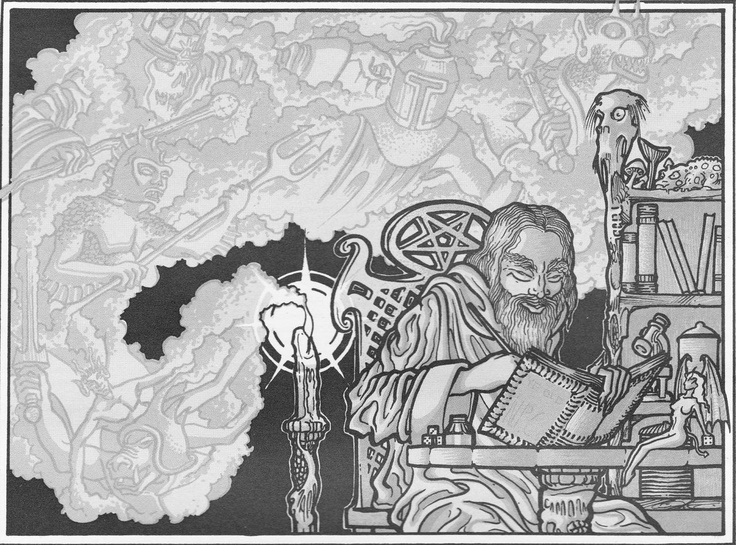
Erol Otus was an artist who did a lot of the art for Old School D&D materials.
I'd guess that his gnarly, creepy style was probably half the reason people thought D&D was satanic.


His cover-art tended to have surreal, glaring colors. But most of the drawings are black and white, begging for coloring. Except who would dare to sully a vintage game supplement? (seriously, half of the old D&D books I've gotten from used book stores have atleast some of the illustrations colored in)

So here are some uncolored scans , straight from the internet.
I present the Erol Otus Coloring book!


NaNoWriMo
 
 Does anybody know what monster this is? It looks like a pumped-up carrion crawler.


 Pow! Bam! Biff! Ker-Sploosh!


Tuesday, August 11, 2015

Recent Lessons

The Dungeon Purgatory campaign may soon be ending. I am moving to another city, so I won't be around to insist that we stick with it. We are also getting to miss the narrative consistency of a more traditional campaign. So Dungeon Purgatory is prolly not long for this world.

anyways, here are some lessons I've learned from running my last few sessions

1. Randomness on the DMing/encounter generation side of the screen does not necessarily equate to randomness on the player/experience side of the screen. Rather, the players can be given a sense of disorder or mystery from events which are actually carefully planned on the DM side. But if the DM expects off-the-cuff randomness to perform well and hopes to surprise himself, he is likely to be disappointed, and what the players experience will probably be meaningless and boring.

2. If you want a monster to stick around and cause trouble for a while, don't make it easy for the PCs to push it off a cliff or into a pool of lava or something. At least not until that is exactly what they are supposed to do.

3. Dungeons are like fun-houses. The aptness of Alexis-senpai's comparison is more apparent to me now. Except I would say it's more like an amusement park haunted-house ride. \


Things need to be obvious. The monsters are supposed to pop out on their creaky hydraulics. If there's a mystery or a secret, it needs to be apparent that there is a problem to be solved. It's ok to hand-hold in dungeons.
Yeah, I am usually for lots of freedom and player-driven action. But dungeons really aren't the place for that. Open ended adventure requires an open environment. Once we are in a dungeon the game is not about getting into character or storytelling. It is about killing stuff and getting treasure until the course is cleared.

4.That said, whether an area is visually mapped or merely described to players has a huge effect on how they are prompted to explore and interact with the environment.
I had a certain area mapped very neatly, but lost it before game. I felt this loss very keenly as I had to describe verbally what I had expected to present visually.

A map encourages players to be more proactive in their exploration. What they already see is clearly marked and the "blank" areas of the map show where there is more exploration to be done.

But when players are dependent on a description farted out of my hazy and disorganized imagination, they really lack prompting. If something is not specifically mentioned in plain language, it may as well not exist. On the other hand, something mentioned as mere window-dressing may utterly fascinate or boggle the players. The tale of the Gazebo comes to mind.

Does it see us?
 
This distinction between visual representation and descriptive representation may seem obvious. But I am still learning it. In the future, I will make a conscious decision about how I intend to present an environment. This distinction also pretty much dictates what sort of preparation will be necessary.
 
5. Mixing monsters is cool. Encounters with multiple distinct monster types are a good way to make a combat more interesting. Having more than two factions involved simultaneously in one encounter can be very unpredictable for players. Especially when one faction is an unknown quantity. It gives players the opportunity to make quick decisions and feel particularly clever when things work out well for them. 


Wednesday, July 29, 2015

Killing Gently

Though my rate of posting has slowed significantly, the Dungeon Purgatory campaign is still going, and the party has come once again to one of my areas. I am playing my cards close to my chest at the moment, but I will share reflections on this level later.

Until then, I've been immersing myself in the Dune universe lately. Even going so far as to listen to the prequels co-authored by Brian Herbert and Kevin J Anderson. They are not nearly as esoteric or perceptive as the writings of Frank Herbert, but are sufficiently interesting for describing the underpinnings of the universe.


Dune is one of those science-fantasy settings where it is the future, in space, but people are still fighting with swords for some reason, which is cool.
Dune's justification for swords-in-the-future is the Holtzmann-Effect shield. The Holtzmann shield is a energy barrier which deflects any object which enters the field at a certain velocity. A person with a shield equipped is invulnerable to any projectile or explosive force. A shield can be personal, or large enough to cover a city.
The only way to penetrate a shield is by moving into it at a sufficiently slow speed. This necessitates a particularly disciplined form of melee combat. And as shields are ubiquitous, military tactics are based around the necessity of close combat.


Shields- as depicted in the 1984 movie. When CG was new.

Holtzmann shields do have some serious limitations however: For one, they attract and enrage the giant worms of Arrakis. So using one in the open desert is practically suicide.
For another, if one is shot with a laser, the interaction creates a detonation equivalent to a nuclear blast. So beware of suicide troops with lasguns. Depending on who you are fighting, that could be a thing.

There have been several attempts to make a Dune rpg. The ones I've perused don't seem too promising. But the schools and disciplines of the Dune universe seem well suited to the Class and Level model.

Thank you, internet.


I got to wonder about Dune Larping. The action in a Dune novel is mostly talking, or intense chemical-aided introspection, punctuated by spying  and the occasional assassination attempt or duel. It seems like it would lend itself well to live-action gaming, so I did a quick search to see if anybody else has wondered about this.


A few have, and fewer still have attempted it.  One of these bold souls wondered aloud how the particular character of holtzmann-shield fighting could be simulated.
I've done some fencing and boffer and SCA combat here and there, so I thought about it.

In shield-fighting, only an attack which enters slowly can penetrate the shield. This is the trick, because in conventional melee combat, the faster hand has the advantage. It seems that this sort of combat would emphasize subtlety, deception and precise control. And that is what we would need to simulate to get the "feel" of shield-fighting.

I noticed that impact or mass-weapons don't play into shield combat. It's all rapiers, bodkins, crysknives, poison needles and hidden blades. These weapons can be manipulated with special finesse, and don't need to be moving fast to deal their damage. Hacking and smashing weapons such as maces, axes and broadswords pretty much need to be moving fast for their mass to play into the damage, as such they don't get used in shield fighting. I don't know much interest Frank Herbert had in martial arts, but he seemed to have realized this distinction when he was building his world.

What occurred to me was a form of boffer-fighitng or fencing where the object is to touch the opponent so that they feel it, but in such a way that it doesn't hurt or even sting a little bit. Every other aspect of the sword-play would be full speed. But being required to pull one's blows would, I think, simulate the challenge of slow-blade shield fighting.

I am actually pretty tickled by this notion. It's a bizarre form of counting coup. Some time when it's not blazing hot out, I will have to get some people together so we can figure out how this works in practice. Things like what kind of weapons to use, what protective gear, if any. Is grappling allowed or not? how to properly gauge a "hit" and so on.
I think there could be a lot of appeal in a martial game where the object is to not hurt your opponent, just show that you could have if you'd wanted to.
anyone seen this episode? it seems relevant.
 
 
Hopefully I will have some results to report on this experiment sooner rather than later. I am pretty excited about it.


Tuesday, July 7, 2015

Something for Everybody

A friend in the Dungeon Purgatory campaign ran in one of his levels last friday.

I would call the session a success, and it had a very basic lesson to teach.

In the little scenario, there was something for everybody to do.
Or nearly so. The character-players had plenty of action. The rogue had a heist to perform in the background. Only the fighter, who suspected a trap was really left out in the cold.

This is a basic idea. Its so obvious, it is in certain editions of the DMG. I guess I am just getting back  to basic lessons after taking such a long break from game.

I mean, I wouldn't  make Something for Everybody the primary principle of my process. But for set-piece encounters or important areas, I will try to keep it in mind.

One thing I noticed about the recent session, was that we split the party without fretting about it. Keeping the party together is like the first rule of dungeon survival.
But somehow, in this scenario, we sensed that we had license to do so. I think it was when the party had found an are which was not technically a "dungeon," And he took a moment to describe several objects, people and simultaneous events at the same time, which was likely to pique and divide our interests at the same time.

Simple stuff.

Monday, July 6, 2015

The Underloft-grid-map lessons learned

After a hiatus out of respect for Med-faire season, we resumed the Dungeon Purgatory campaign.

Over the last two sessions, we returned to and completed one of my levels.

The Underloft.
The Underloft may be thought of as the flooded-basement of the castle complex. A vast, subterranean space, wet, cold, dark and dripping.
Something like this image of Dwarrowdelf from LotR, except flooded.


I liked the idea of the Underloft. it was very archetypal. I thought the atmosphere would translate easily, and I thought it would be a good opportunity to use the Zelda-Grid style map.

The players recently made their second expedition to the Underloft, in search of a key which would grant access to new areas.
And I swear, it was the most boring couple of sessions I have run in recent memory.

One of the problems was misuse of a random encounter table. As the party progressed from gridsquare to gridsquare, I would roll away on a d20 encounter table to see what appeared in adjacent grids.
This gave me a lot of nonsense and things that Either I didn't feel like running, or else some nonsense encounter.
Fortunately, the table producd a merchant with a boat for sale. So the PCs could traverse the waters without suffering hypothermia.
Then it so happened to yield the Boss with the McGuffin they were looking for.

I went in thinking that adherence to a random table would produce an organic experience that would surprise everybody. What I got was either nonsense, or unappealing. Really, it would have been better if I had simply plotted to a certain extent.

We are using a spell failure table for this campaign. Spells require a spellcraft check with a difficulty based on the spell level. This makes it possible to fumble spells. Fumbled spells call for a roll on a  d100 table listing various effect, some benign, some terrible.
Somebody failed a spell, and as a result evaporated all water in a 1 mile radius.
This Dried up the whole level. The party was able to walk to the exit.
Near the exit, they stumbled upon the same merchant. How the merchant got there before them was not explored. But the only reason for it was my use of the random encounter table.

I think it would have been better to track the significant objects over time according to the reasonable natures of the object, rather than relying on the random encounter table. It would have created a greater sense of depth to the level. Even if this would have been imperceptible to the players, I would have felt better about it. Adherence to a random table for generating encounters off-the cuff was a bad idea. I use random tables when populating areas beforehand, but I don't obey them if I don't feel like the result is appropriate. Why did I have this temporary lapse? Must have been too long since I last DMed.

Next time will be better.